
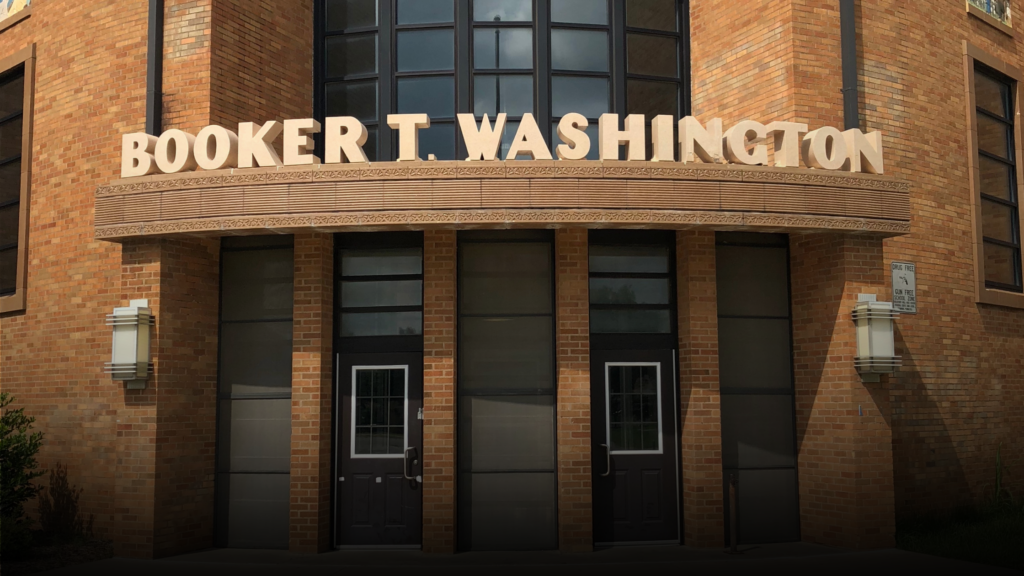
Before the name Booker T. Washington belonged to one of Tulsa’s most storied high schools, it belonged to a man whose ideas about Black education, economic advancement and self-determination were influencing Black communities across the country.
Born enslaved in Virginia, Washington became an educator, author and the founding leader of Tuskegee Institute. At a time when Black Americans were confronting segregation, racial violence and systematic exclusion from economic and educational opportunity, Washington believed deeply in education and in developing the skills, institutions and economic foundations Black communities needed to create greater opportunity for themselves and future generations.
Those ideas carried particular significance in early 20th-century Tulsa, where segregation shaped where Black people could live, learn and work. Black Tulsans responded by building institutions of their own, and as Greenwood grew, its churches, schools, businesses and professional class created an infrastructure that allowed families to build lives and opportunities within a city that denied them equal access elsewhere.
It was in this Tulsa that Booker T. Washington High School was founded in 1913.
The original school consisted of four rooms, but Tulsa’s growing Black population soon required something larger. By 1920, a new three-story brick school stood in Greenwood, where students studied subjects including Latin, bookkeeping and physics and prepared to pursue higher education and professional careers.
Under its first principal, E.W. Woods, who would lead Booker T. Washington for 35 years, the school became known for expecting its students to see possibilities for themselves beyond the limitations segregation attempted to place upon them. Woods captured that expectation in a message remembered by generations of students: “You’re as good as 99 percent of all people and better than the rest.”
By the spring of 1921, another class of Booker T. Washington students was preparing to step into the future the school had helped prepare them for. In their yearbook, the graduating class looked ahead to what they called “the great outside life.”
Within weeks, their community would be attacked.
Students, faculty and families were displaced and traumatized during the 1921 Tulsa Race Massacre, and young people who should have been preparing to celebrate the end of another school year instead became living witnesses to the atrocities inflicted upon Greenwood.
Sixteen-year-old Bill Williams, captain of the Booker T. Washington football team, had been helping decorate for the senior prom on May 31 when students were told to go home as danger grew. During the Massacre, Williams was detained by armed white men and taken to Convention Hall, one of the locations where Black Tulsans were held. His family also lost the Dreamland Theatre and other property in the destruction of Greenwood.
Prom and graduation were canceled that year, but Booker T. Washington remained standing.
In the aftermath of the Massacre, the school became part of Greenwood’s response to the devastation, serving as an emergency center for the wounded and a headquarters for American Red Cross relief efforts. Classrooms and hallways built to educate Black children became spaces where a wounded community sought care and began the long work of recovery.
Then students returned, and generations continued to follow them.
Today, Booker T. Washington is one of the surviving institutions with roots in the Greenwood that existed before and during the Tulsa Race Massacre. Its significance is not simply that a building survived the destruction around it. For more than a century, Black families continued sending their children through its doors, and those students became educators, entrepreneurs, artists, professionals, advocates and leaders in Tulsa and far beyond it.
That history matters to Justice For Greenwood because the story of Greenwood has never existed only within the two days of the Massacre.
The conditions that shaped Black life in Tulsa did not begin on May 31, 1921, and their consequences did not disappear when the fires went out. Black Tulsans were already navigating systems that restricted where families could live, where children could learn, where people could work and their ability to build and protect wealth. The Massacre brought extraordinary violence upon that community, but the racial and economic barriers surrounding Greenwood continued to shape the generations that followed.
Understanding that history also changes how we think about repair.
Our work continues with descendants and families still living with the consequences of what happened in 1921, while reaching further into what recovery can mean across generations. It means preserving the history that others tried to erase, strengthening the institutions that Black communities fought to build and connecting families and young people with resources that can help them build, protect and pass forward something of their own.
Booker T. Washington brings those pieces of the story together.
Its survival gives us a direct connection to the Greenwood that existed before the Massacre, while the students filling its classrooms today remind us that preserving an institution is only part of the work. We must also ask what the next generation needs to thrive within it and beyond it.
The young people walking the halls of Booker T. today should know the history they inherited, but their relationship to Greenwood should never begin and end with what was destroyed in 1921. They also inherit a history of Black institution-building, education, entrepreneurship, professional achievement and community care.
And they are building histories of their own.
That is part of why Justice For Greenwood will be back in community at Booker T. Washington on September 18 for Homecoming. We will spend time with students, alumni and families, share more about the resources and work happening across our movement and, most importantly, hear from the young people preparing to become the next generation of Tulsa’s professionals, entrepreneurs, educators, artists and community leaders.
If you are coming through, find the purple tent. 💜
Come talk with us about your family, your connection to Booker T. and Greenwood, and the future you want to see for this community. If you are a student, we especially want to hear what you are working toward and what you hope to build.
More than a century ago, Black Tulsans built Booker T. Washington because their children deserved an education and a future even when the systems around them refused to provide equal access to either. Students walked through those doors before the Massacre, returned in the generations after it and continue to fill its classrooms today.
Their history should tell the next generation more than what Greenwood endured.
It should give them something to build from.